Saturday, 23 January 2016

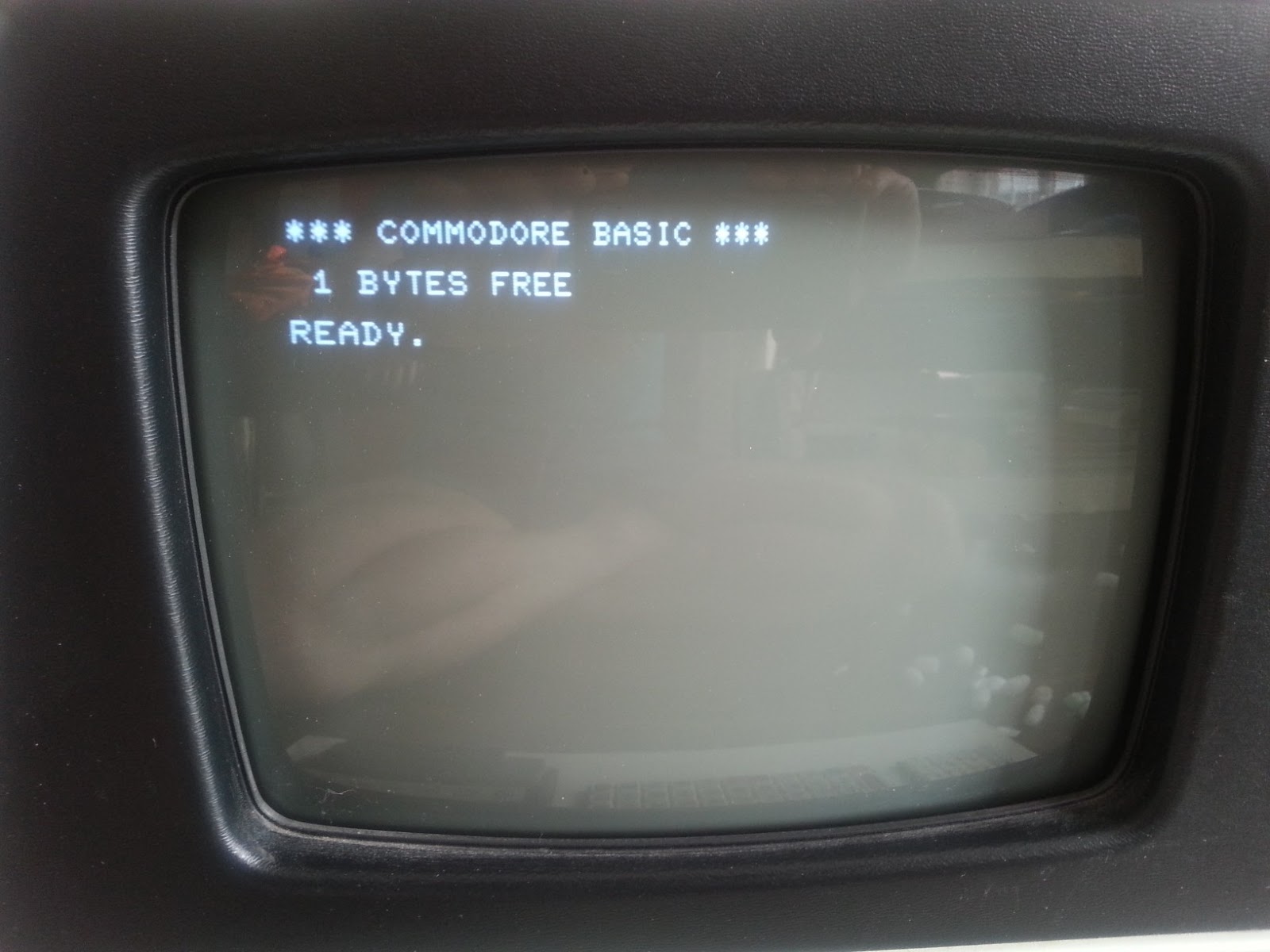
A new Commodore for my collection!

I am very lucky: I got a fully working chessmate with PSU


The machine was built in 1979 - with 2 "very large" 2111 SRAM (256x4) = 256 bytes
and the 6530-024 RRIOT with the 1kB microchess-code from Peter Jennings.
The CPU is the 6504 - a 6502 with limited address lines:

:


Sunday, 11 October 2015

Unbelievable - a second HP B7XX !

Yesterday I got a second High Profile machine: It's a regular B710 (@ right)!
The PSU was defective - but it was easy to repair that.

Who in the world owns two HP-machines? ;-)


The differences to the Prototype (@ left):
Keyboard in beige/green color, sticker instead engraved Commodore, plug in the monitor-power-cable, only 128kB RAM, three 2764 ROMs on adapter-board


It's made in germany 


I have to clean it!

Monday, 5 October 2015

A new computer for my collection!

A new computer for my collection just arrived.
...but it hasen't much RAM inside ;-)


The machine has the orignal MPS 6540 RAMs and MPS6550 ROMs!
It's in a very good condition:


Friday, 14 August 2015

Oldschool Programming-tool ;-)

Today I got a very old programming tool from the USA - the 1977 TI Programmer.
First I cleaned it and changed the accumulator against a 9V-battery:


This very cool machine is able to write my nickname with the TI-custom chip:

 
Now it looks like new:


Saturday, 6 June 2015

Raster IRQ & collision working

The last things from my to-do-list are now realized:

- sprite-sprite-collision detection
- sprite-background-collision detection
- collision-interrupt enable / flag setting
- raster-interrupt enable / rasterline setting

 
I coded a simple routine to test the raster-interrupt. It changes the background (38 column-mode to see the frame at the sides) and framecolor at rasterline 00, 6f and fb. This works but some times the screen flickers a little bit - it's not perfect ;-)
 

The collision-detection works perfect. After a whole screen the bits of the involved sprites were set in the colliosion registers. Also the source-bits in the IRQ-flag register were set. If one of the irq-mask bits are set, an interrupt will be outputted for only 15 us because clearing the IRQ is not possible.
My Atxmega don't recognise a write to the flag-register!
I clear the raster-irq-flag and the collision-flags after one rasterline.

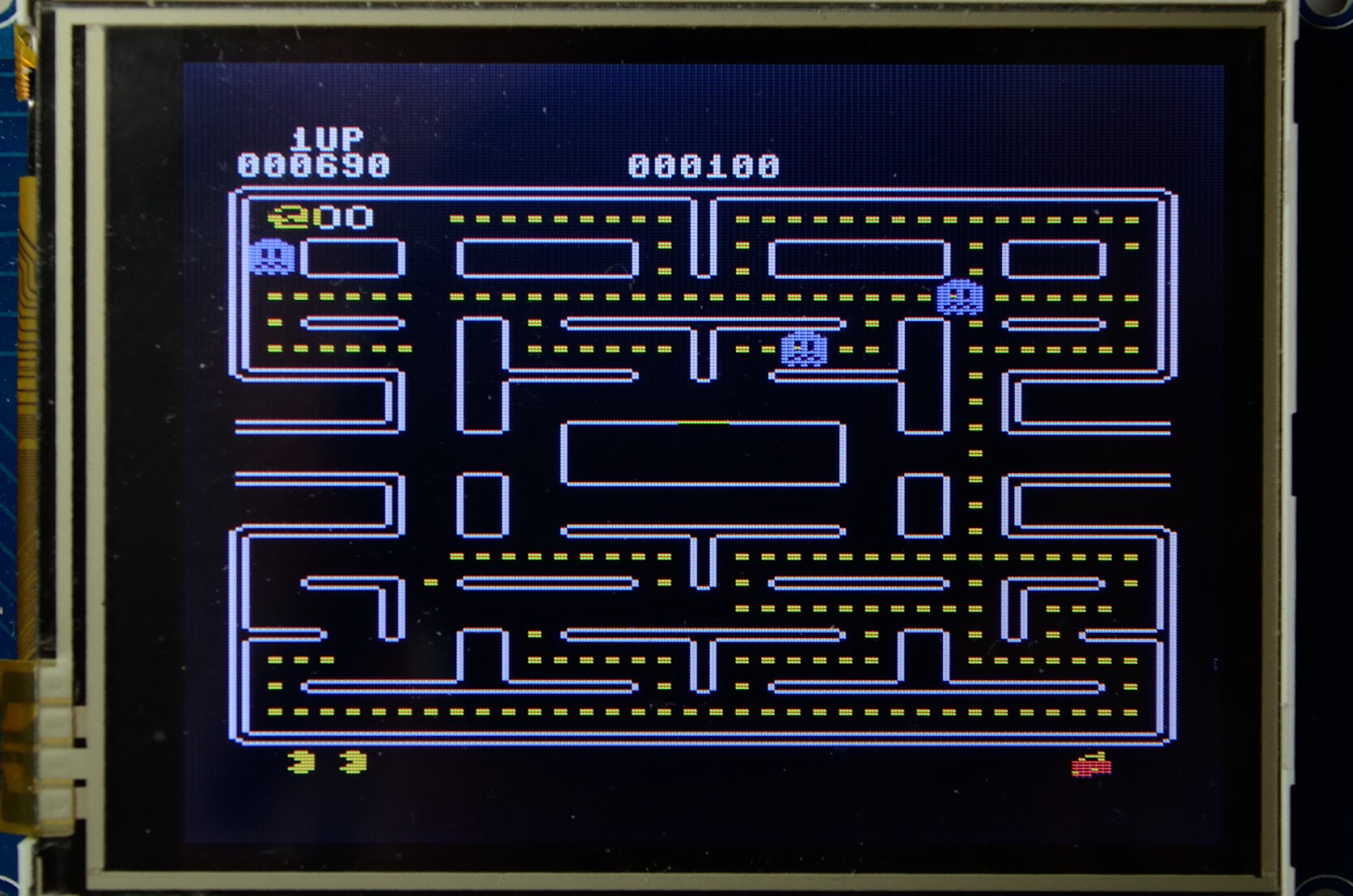
Now PAC-MAN can eat ghosts:

 
Soccer now runs with players  on the field. The game uses sprite-multiplexing.
This doesn't work properly because I update the sprite-data only 3 times on a screen.
I tried to update the spritedata everytime a sprite starts in a rsterline but this reduces the refreshrate too much (10-12 Hz).
 
 
Donkey Kong now works, but some colors are wrong - I don't know why?
The game has some sprite-errors (Kong) and runs very slow.
I think the speed of many games like Donkey Kong, GORF or int. Soccer depends from the VIC-rastercounter. The VIC draws the screen 50 times per second (PAL) - but the xmega only do it about 20 times / second.


Sunday, 31 May 2015

Rastercounter / Raster-IRQ

With some changes @ the XMega I implemented the last VIC2-details:
 
- VA14/VA15 inputs now @ Port R0, R1 (crystal-inputs) - I use the internal 32 oszillator with PLL
- display reset direct to VCC
 
 now I have 3 new I/Os free:
 
- output enable for the LVT245 databuffer to the XMega
- direction of LVT245 combined with write to GAL (there added to write to RAM)
- IRQ with NPN transistor
 
Now some games like GORF, Jungle Hunt and DigDug are running and International Soccer starts (without players on the playfield?) ;-)
 
The rastercounter works exactly for every line!
I tested the rastercounter with some small assembler-routines like this (38 column mode):


Here is the timing @ the logic16:
 
- At first the Xmega sends RDY to the GAL (0)
- if R/W (1) is high the RDY goes to the CPU (2)
- after 3 us the CPU secure stops and the XMega sends AEC to the CPU-adressbuffer (3) and OE to his Xmega adressbuffers (4)
- Than he reads the rastercounter and sets the transistor (7) -> CPU-IRQ goes low (8)
- the Xmega disable the databuffer outputs (5), sets the write line to the GAL and the direction of the databuffers (6)
- than the controller enables the databuffers to write the IRQ-flag to the RAM (D019).
- now the XMega disables the databuffer-outputs (5) and disables the write/direction-signal (5).
 
I tried to set 5 and 6 at the same time high after writing, but than the system was unstable.
Now I disabled the outputs 30ns before end of write (negative data-holdtime) - but thats not a problem because of low cmos-loads the datalines are stable long enough! 
 

Saturday, 23 May 2015

VIC-Emulation finished!

VIC2-Emulation in the Xmega 128 finished:
 
- refreshrate between 24 and 28 Hz
- userfont with 10 Hz refresh rate
- multicolor, enhanced color, bitmap, multicolor-bitmap
- 38/40 column + 24/25 line with softscrolling
- screen disable, with only short 4us CPU-stops to check if enabled - so jiffy-DOS should work!
- sprites with multicolor, expand x/y, background priority
- sprite-data with about 75 hz refresh
- illegal screen modus
- all CPU-stop are shorter than 30 us / 42 us is OK for disk-loading with normal speed + screen on.
 
Not implemented: Raster-IRQ, sprite collision detection -> Emulation is possible, but I have to write to ram for this - and now the xmega only reads!
 
I'm so happy: Loderunner is full playable - it don't uses collision detection ;-)
 

With Pac-Man I can reach new world-highscores, because I cannot die ;-D
 
 
Pipes is full playable - it uses multicolor, but no sprites:


Multicolor-bitmap-testscreen:
 
 
Donkey Kong reaches only the start-screen:
I think many games needs the raster-register!


In Pole Position only the startscreen works.


 I will add the second CIA / 7406 to test some games from disk...


Wednesday, 13 May 2015

Added scrolling, bitmap & multicolor-mode / PLA OK

Now I implemented successful the bitmap-mode to my Xmega-VIC2.
Also I added 38/40 column and 25/24 Row modes with soft-scrolling horizontal and vertical.
Scrolling is possible in character and bitmap-modes.
 
 
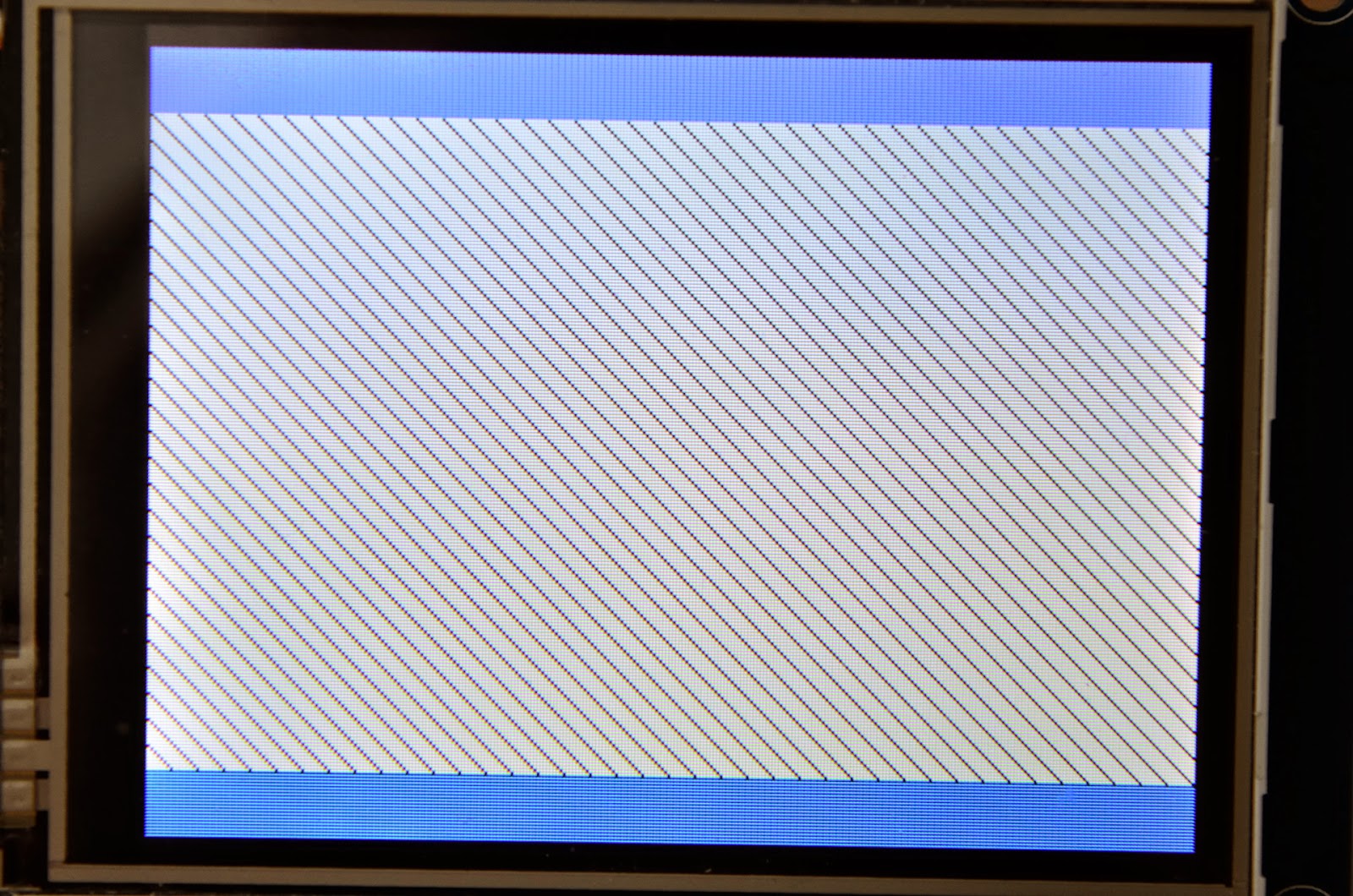
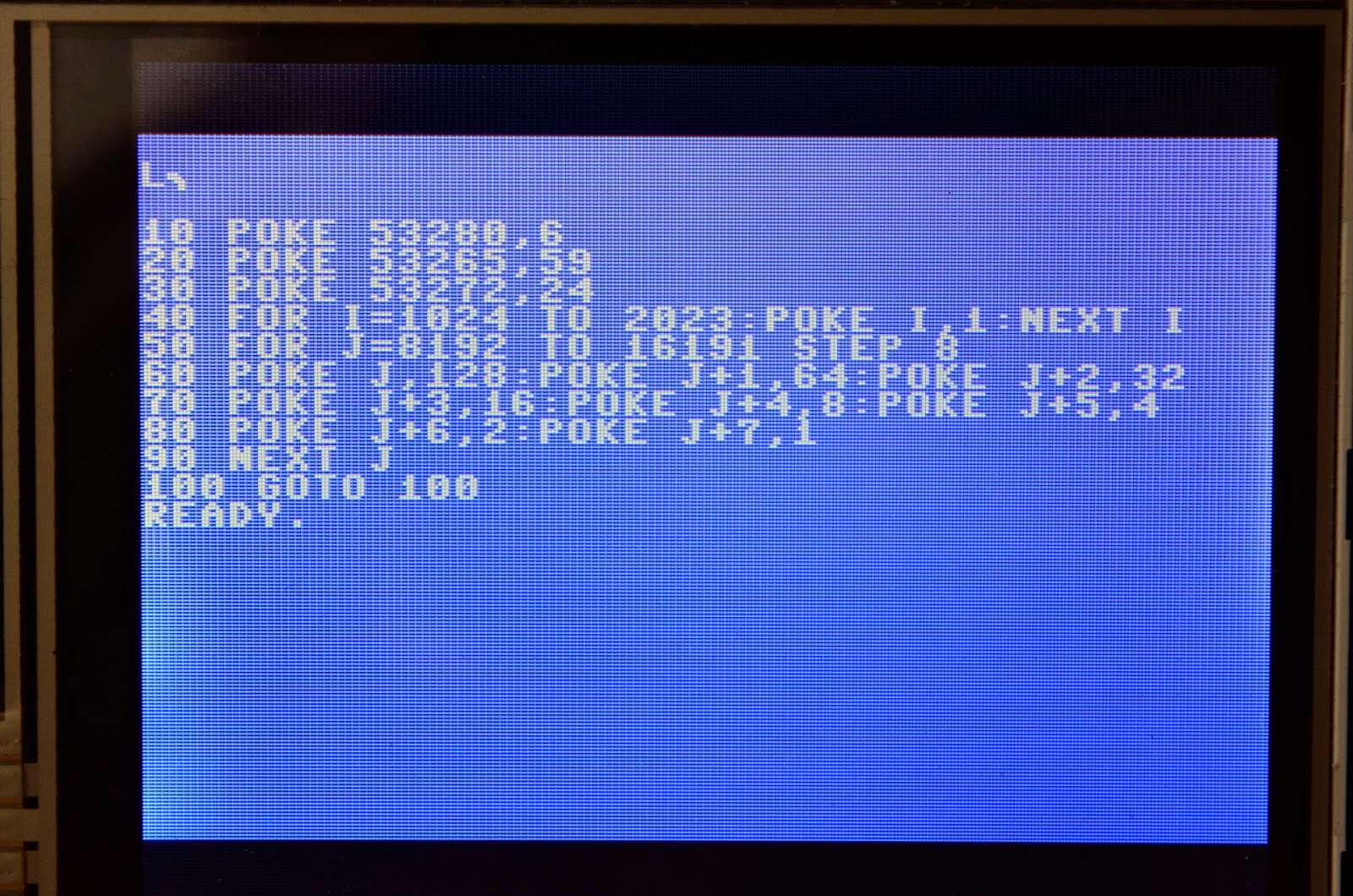
This is the small basic-program to test the bitmap-mode with the screen above:
 

I added the multicolor-mode to my Xmega-code and now PAC-MAN looks right - but sadly still without the sprites ;-)

 
AMC is not in multicolor-mode but the colors weren't OK.
Now the colors are great:
 

The Commodore Diagnostic now writes that my PLA (82S1) is not bad (I think it is because I implemented CHAREN).
In the second RAM-Test the screen goes crazy, because I use the RAM from D000 to D3FF as VIC-registers. The SID and the 2nd CIA are BAD because they are not present. The first CIA is BAD because of the missing TOD.


Sunday, 10 May 2015

Added enabling character-ROM

Now I added the CHAREN signal of the port 0001 from the 6510 to enabling the character ROM.
PAC-MAN and Pipes uses this to read the letters and numbers from the built-in-font to save memory in the cartridge-rom.
I use now 2 GAL22V10 because I need all the outputs.
The CHAREN is detected in the second GAL and stored in a D-Latch like LORAM/HIRAM.
 
PAC-MAN uses multicolor-textmode - I have to add it in the Xmega now :-)
 
Gameplay-Video - now with Joystick :-) but without sprites ;-(   PAC-MAN-gameplay


Pipes uses CHAREN too - and works now perfectly!


Real gameplay on my LC64 :-)

After finishing the user-font-implementation I tested some ROM's:
 
The Commodore Diagnostic-Cartridge (without the test-dongles) runs, but at the second RAM-test the screen disappears... - it comes back at the next count.
U2, U18, U17 are bad because they are missing ;-)
And maybe U1 is bad because in the 8520 is no TOD.
And the 6510 is OK ??? - It's a 6502 :D :D :D
 

AMC is full playable because it don't uses sprites :-)
It only works with user-fonts - and they are working perfectly!

YouTube: AMC Gameplay


 Pac-Man runs but the start-screen looks crazy?

 
It's real FUN to play without sprites!
You only see the maze and eating the cakes - but you don't see Pac-Man and the ghosts :D :D :D
 
YouTube: PAC-MAN Gameplay  (without sprites & without Joystick port 1)
 

Pipes has some screen-errors but it runs and is playable...


The Terminal-Interface Cartridge works:


A real MSX for my collection ;-)

I got a real MSX 1 - machine!

It's a Yamaha CX5M with the built-in SFG-01 FM-synthesizer-unit.
I also got the YRM-103 DX7-Voicing Program. With this I can plug in my DX7 and edit the FM-sounds ;-)

Because the power supply was missing I took an external HD-supply with +12V / +5V and soldered it to the very special 13-pin-DIN-plug! With a Murata DC/DC converter I generate the -12V in the CX5M (on the board it generates -5V for the 3-voltage-DRAM's).

I built an audio-cable for the mini cassette recorder and now I'm able to load and save.

The SFG-01 sound-unit was easy to update to the SFG-05. I only needed to change the 16k ROM to the new 32k EPROM and add an extra wire for A14.

 
The CX5M uses the old TMS 9929 with 8 1-bit-DRAMs:
 

Saturday, 9 May 2015

VIC-bankswitching & user-fonts

Today after the hardware is nearly finished I worked at the VIC-emulation.
I added the VIC-bankswitching (VA14, VA15) with 2 inputs in the Xmega. My xmega-VIC can use the RAM under ROM for screen-memory or userfonts - like in the real C64.
Userfonts are now possible:


The xmega detects the characterset-page-switching and loads it completely from the RAM in the xmega-RAM.
After that before every screen row the xmega loads 32 bytes of the actual font - so that about 10 times per second the complete userfont will be new loaded, to get possible changes of the font.
The whole xmage-RAM-downloading of the screen, the colormemory, the register and the userfont steeles the 65c02 only 35 milliseconds of a second !!!

Friday, 8 May 2015

Real CIA + CPU-Port-simulation

Now I found out that there exists a CIA in PLCC !!!
It's the 8520PL from the Amiga 600/1200. The only difference to the 6510 is that CSG changed the TOD to a 24-bit timer. But who need the TOD in the C64?

 
With the 8520 I can run the nearly unmodified KERNAL. The only thing I have to change is the PAL/NTSC detection, because I have no VIC and the KERNAL hangs in a screenline-read-loop.
 
I added a GAL16v8 that detected (together with A8-A15 from the GAL 22v10) the write to the CPU-port at $01 and stores D0 and D1 in two D-latches. The 16v8 gives LORAM/HIRAM to the adress-decoder in the 22v10.
Now I can turn off the BASIC and the KERNAL like in a real C64.
Also I burned Handic's MON-64 in the 32k-eprom before the basic and I can activate it by the EXROM-input of the GAL.
I wrote a small program (see below) to test the writing under the ROM, deactivating it and read from the RAM. - it wokrs !!!

Tuesday, 5 May 2015

CPU-Timing measurements

Today I made some measurements with the Rockwell R65c02 @ 4.096 MHz to check the system-timing, to verify the CPU-datasheet and in the last picture to compare it to the WDC.

Phi0(in) to Phi2 - 20 ns/cm -> 14 ns delay
Phi2 to adress - 20ns/cm -> 37 setup / 30 ns hold time
Phi2 to data - 40ns/cm -> -20 write data delay / 85 ns hold
Adr to CS - 20ns/cm -> 10 ns delay (15 ns GAL 22v10)
Phi2 to CS - 40 ns/cm -> CS time = 235 ns 
CS to data - 40ns/cm -> 145 ns before / 55 ns after CS high

WDC W65c02
CS to data - 40ns/cm -> 125 ns before / 50 ns after CS high